
On this page
Introduction
A seafood display needs ice at particular times, not simply a total number of kilograms by the end of the day. An opening fill can empty a store before enough replacement ice becomes available. A machine rating and a daily consumption total do not reveal that timing.
This guide turns the seafood application brief into a worked purchasing record. All quantities in the example are hypothetical. They are not customer consumption figures, a food-handling procedure or a performance test of an ICES machine.
1. Define what leaves storage
Use one boundary for the calculation: ice available in the storage arrangement that supplies the display. The opening fill, later top-ups and separate preparation uses are withdrawals from that store. Track each movement once on its correct side of the storage boundary.
For an operating counter, weigh and record representative withdrawals. Note the counter, task and required time. Counter dimensions and bed depth describe the arrangement, but do not establish the ice mass on their own; do not insert an assumed bulk density to turn a picture or bed volume into a confirmed requirement.
- Record the first fill at the time staff must start using it, not merely the public opening time.
- Separate display top-ups from kitchen or preparation batches.
- Include every counter using the same storage so simultaneous withdrawals remain visible.
- Record the operating day represented, including unusually busy periods and any gaps in measurement.
2. Count additions only when the ice is usable
An addition belongs in the record when ice becomes available in the supplying store. Ice made earlier and already in storage belongs in the opening stock, not in a second addition during the day. Ice that will arrive later cannot cover an earlier withdrawal.
For a proposed machine, obtain production information for the relevant conditions and operating schedule. Dividing a catalog kg/24h figure by 24 does not establish that a selected machine will deliver that amount to usable storage in every hour. Keep the proposed machine, configuration, ambient and inlet-water conditions connected to the evidence.
Keep transfer, discard and storage-loss records explicit. The worked example below uses hypothetical net usable additions and omits a separate storage-loss allowance. For a real brief, either record net additions or record gross additions and losses separately; do not deduct the same loss twice.
3. Work through a timed example
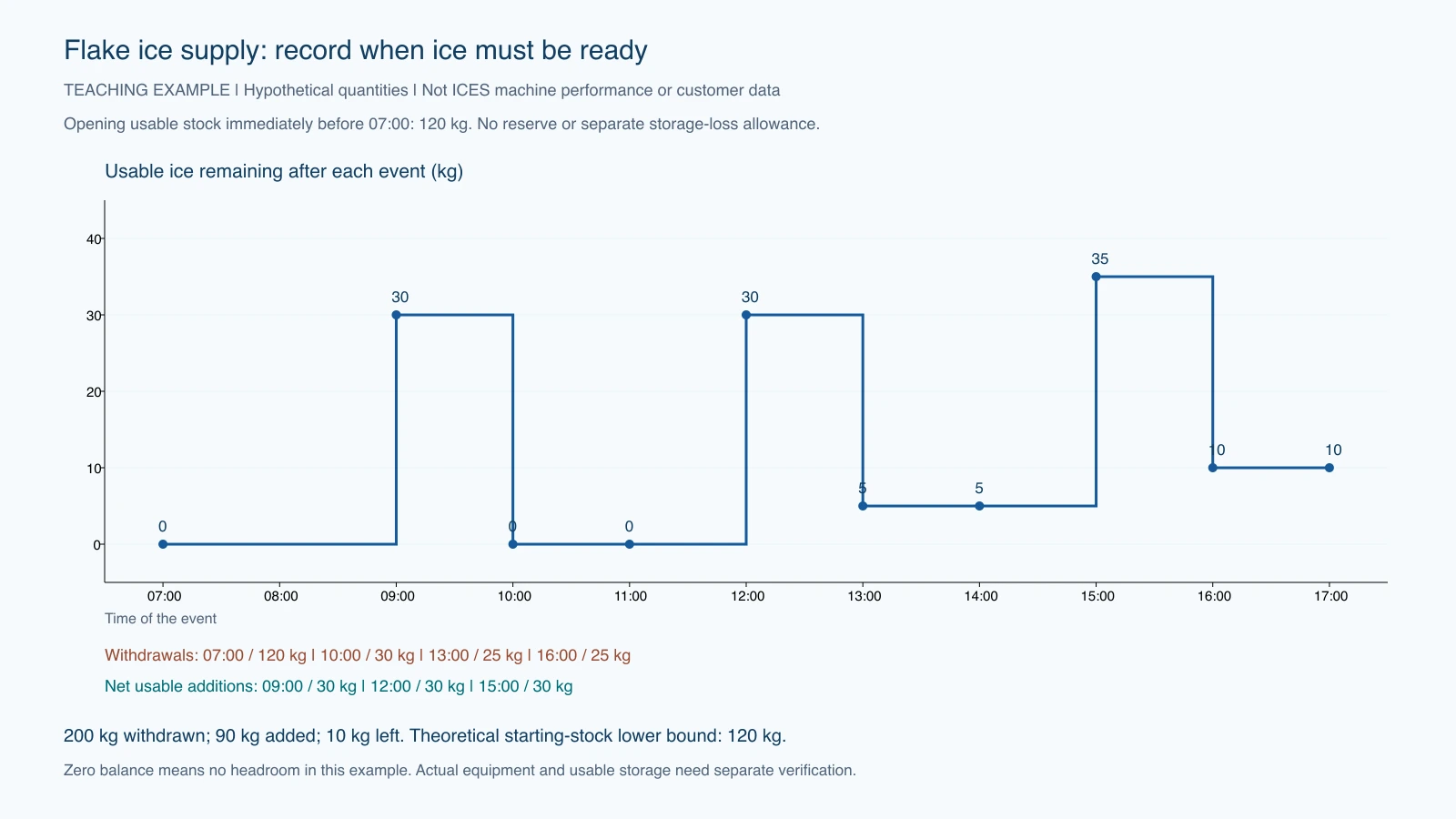
Teaching assumptions: the supply store contains 120 kg of usable ice immediately before 07:00. Staff take 120 kg for the opening fill, then 30 kg, 25 kg and 25 kg for later tasks. Three hypothetical additions of 30 kg become usable at 09:00, 12:00 and 15:00. These batches do not describe any ICES model or measured production curve. No reserve or separate storage loss is included.
| Time | Withdrawal from storage (kg) | Net usable addition (kg) | Ice remaining after event (kg) |
|---|---|---|---|
| 07:00 | 120 | 0 | 0 |
| 09:00 | 0 | 30 | 30 |
| 10:00 | 30 | 0 | 0 |
| 12:00 | 0 | 30 | 30 |
| 13:00 | 25 | 0 | 5 |
| 15:00 | 0 | 30 | 35 |
| 16:00 | 25 | 0 | 10 |
The withdrawals total 200 kg: 120 + 30 + 25 + 25. Additions during the period total 90 kg: 30 + 30 + 30. The store ends with 10 kg: 120 + 90 - 200.
The daily net draw is therefore 110 kg, but starting with 110 kg would miss the first withdrawal by 10 kg. The 120 kg opening fill happens before any of the assumed additions. The largest cumulative shortfall is 120 kg, so that is the theoretical opening-stock lower bound for this particular schedule.
Zero remaining ice after 07:00 and 10:00 means the example has no headroom at those points. It is not an approved operating plan or a recommendation to buy a bin labelled 120 kg. A real decision must account for usable storage, losses, variability and the reserve the operation can justify.
4. Test the timing, not just the total
Now delay only the first 30 kg addition from 09:00 to 11:00. Keep the other quantities and times unchanged. Daily withdrawals remain 200 kg and daily additions remain 90 kg, but there is no new ice before the 10:00 withdrawal.
By 10:00, cumulative withdrawals are 150 kg and cumulative additions are zero. With the original 120 kg opening stock, the arithmetic balance would be -30 kg. That negative value represents an uncovered requirement, not physical negative ice. The theoretical opening-stock lower bound rises to 150 kg.
This is why the supplier needs a timeline. Equal daily totals can hide different ready-time requirements. If the timing of usable supply is unknown, keep it unknown in the brief; do not replace it with an unverified flat hourly rate.
5. Use a stock check that can be audited
At each recorded event, calculate: remaining usable ice = opening usable stock + cumulative net usable additions - cumulative withdrawals. Use the same storage boundary and mass unit throughout.
The theoretical opening-stock lower bound is the largest positive value of cumulative withdrawals minus cumulative additions across the recorded times. Include an initial zero baseline. If a real record includes separate loss or discard events, include them among the withdrawals before calculating this bound.
Use the calculation to identify a timing gap, then examine how it could be addressed: a different verified supply schedule, a different usable storage arrangement or a revised operation. Do not change required display quantities or handling procedures merely to make a spreadsheet balance. The model alone does not establish the right reserve.
If additions and withdrawals are recorded at the same time, also record their order. A delivery available at 10:05 does not cover a 10:00 refill. If the order cannot be established, do not silently assume the supply arrives first.
6. Build a record that purchasing can use
| Record | What to enter | Why it matters |
|---|---|---|
| Event date and time | When usable ice arrives or must be withdrawn; add event order where needed. | Preserves ready-time requirements. |
| Counter or task | First fill, named top-up, preparation batch or another shared outlet. | Separates uses and prevents double counting. |
| Mass withdrawn | Measured kilograms and how the quantity was recorded. | Connects the brief to actual demand rather than an assumed density. |
| Net usable addition | Kilograms actually available to this store, or a clearly identified assumption. | Distinguishes measured supply from an unverified machine rate. |
| Loss or discard | Measured loss/discard, or an explicit unknown; state whether already netted. | Avoids omitting or double-counting the same amount. |
| Opening usable stock | Ice available before the first event; identify the storage arrangement. | Provides the starting balance. |
| Conditions and exceptions | Operating hours, ambient/water information, transfer constraints and missing data. | Shows which evidence is still needed before a model decision. |
Keep measured values, estimates and unknowns visibly different. A quiet day is a record of that day; it does not establish the busiest service requirement. Use the site’s records to decide which additional operating periods should be observed.
7. Connect the brief to the proposed equipment
Use the ICES flake ice range to see the current catalog-rated models, then bring the timed record into a model-specific discussion. The catalog lists nominal daily production from 300 to 1000 kg/24h; this example does not select a model within that range.
- Supply the opening-stock requirement, withdrawal schedule and the basis of any reserve.
- Identify the proposed bin or storage arrangement and its usable capacity, not just its product name.
- Review the selected machine’s relevant production conditions and schedule, including any periods unavailable for production.
- Keep machine water, drain, power and ventilation requirements separate from the display’s own drainage and handling arrangements.
The supplied ICES catalog is the source for the public nominal product range. Its two-page version does not provide a complete model-specific production curve or a confirmed usable-storage schedule for this worked example. Those remain equipment-selection inputs, not numbers to infer from the illustration.
When quotations arrive, use the quote comparison guide to align configuration, included storage and the evidence behind the proposed supply. This ice-supply calculation does not set seafood holding temperatures, shelf life or cleaning procedures.
Questions Before You Select Equipment
Can I choose a machine because its daily rating exceeds 200 kg?
The 200 kg is only the hypothetical withdrawal total in this example. A larger catalog daily rating does not by itself show when usable ice will be ready or how much can be stored. Review the time record, conditions and usable storage together.
Should the opening fill and later top-ups be added together?
They belong in the total if they are separate withdrawals. Keep their times as well as their sum. Opening stock is the starting balance; exclude it from the later-additions column.
What if actual production or storage loss is unknown?
Mark the input as unknown and request relevant records or model information. You can still prepare the demand side of the brief. Keep any teaching assumption visibly separate from measured evidence; do not approve equipment using a convenient invented rate.
Bring a Timed Brief Into the Equipment Discussion
Record the opening fill, later withdrawals and usable additions in time order. Identify the largest uncovered requirement, preserve the assumptions and use the record to compare verified supply and storage. The result should be a clearer equipment brief, rather than a single unexplained kg/24h target.