On this page
Introduction
An ice machine sample is useful when it answers a defined purchasing question. Without a plan, evaluation can become a collection of photographs, a brief demonstration, and a general impression that the machine “looks good.” That is a weak foundation for a distributor's repeat orders or a brand's product launch.
A better approach connects the sample to the proposed bulk configuration and records what was actually observed, under which conditions, and against which agreed reference.
This is a buyer's evaluation framework, not a laboratory test standard or a report of an actual ICES test. Technical checks should be performed by suitably qualified people using the manufacturer's applicable documents.
1. Write the sample objective before ordering
Begin with the decisions the sample must support. You may need to verify the ice form, review the physical product, assess the proposed configuration, prepare a local demonstration, or evaluate how the equipment fits a customer application.
Different objectives require different arrangements. A machine supplied for an appearance review may not answer every performance question. A development unit may not represent the final production configuration.
Record the intended users of the result: purchasing, technical service, product management, or a project team. Ask those people what evidence they need before the sample is shipped.
Keep the objective specific
Instead of “test quality,” write: “Confirm the sample identity, review representative crescent ice, assess operation using the applicable instructions, and record any differences from the proposed bulk specification.”
This can be turned into a checklist. “Quality” alone cannot be evaluated consistently without defining what it means for the purchase.
2. Establish the sample identity
Record the exact model, ice category, serial or other unit identifier where supplied, proposed electrical configuration, and included accessories. Link the unit to the quotation and specification revision.
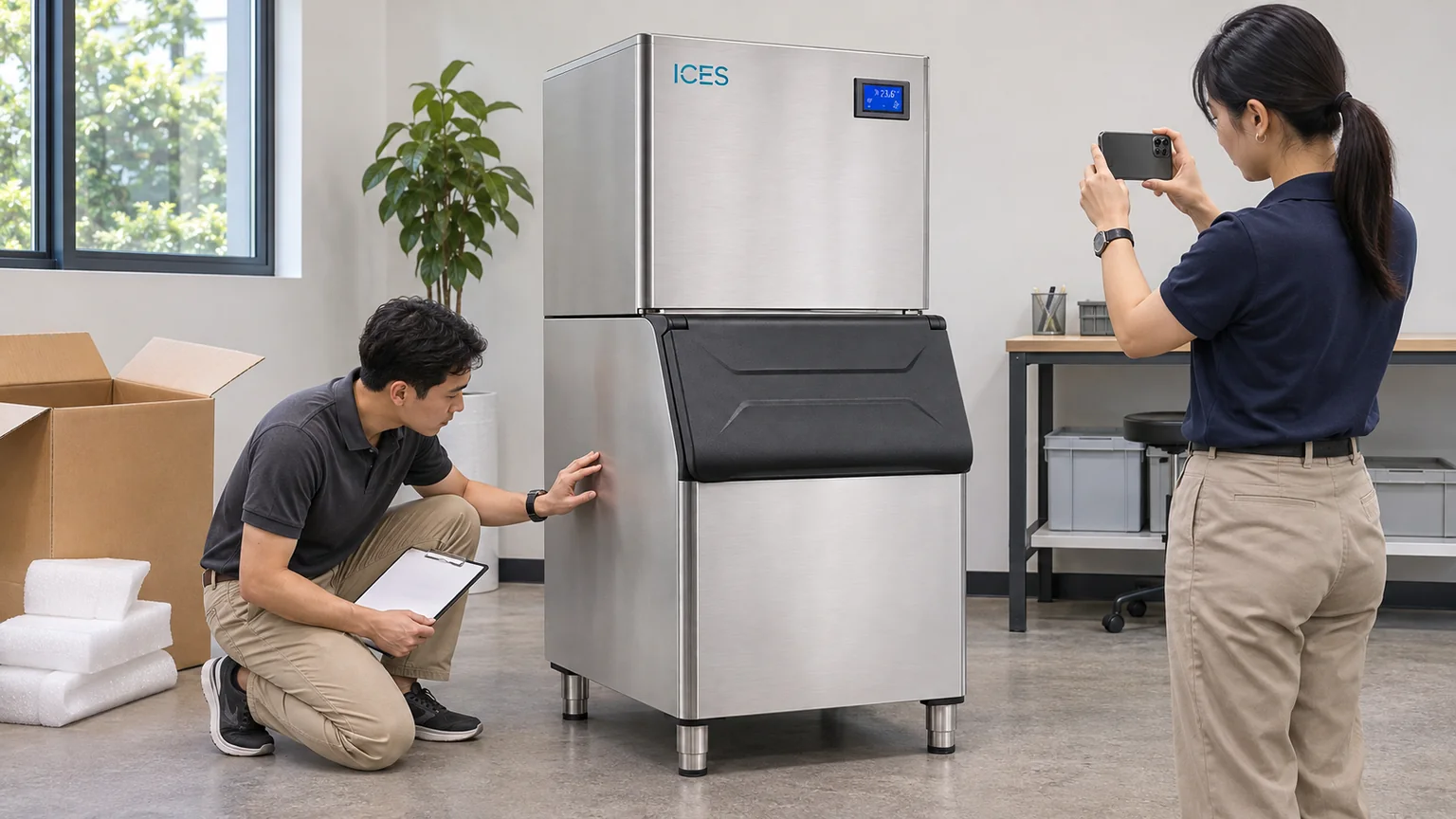
Photograph the received equipment and nameplate clearly. Keep those images in the evaluation file rather than relying on a generic product photograph.
Ask whether the sample differs from the planned bulk version. Possible differences should be listed explicitly, including temporary artwork, prototype parts, document revisions, or accessories that are not included in the order proposal.
A sample approval should state which configuration it represents. It should not automatically authorize later substitutions or unrelated variants carrying the same family name.
For ICES, begin with the relevant category in the product overview. Use the catalog to identify the nominal range, then request the proposed version's applicable documents.
3. Agree on the evidence and acceptance references
Before running the machine, agree on what will be checked, how it will be checked, and what constitutes an acceptable result for the purchasing decision.
The plan should distinguish document review, visible-condition checks, ice-form review, operational observations, and any measured performance evaluation. Each needs its own reference.
If a particular output claim matters, request its stated conditions and test basis. Do not invent a universal tolerance or declare that all samples must run for an arbitrary number of hours.
Identify who records the observations and who approves the decision. Where an independent or specialist test is needed, scope it separately. A buyer's internal checklist is not equivalent to accredited certification.
A useful record contains the item, applicable requirement, method, observation, evidence reference, result, and follow-up. That structure makes disagreements easier to investigate because the original question remains visible.
4. Prepare the receiving and installation environment
Inspect the shipment on arrival and record visible packaging condition before unpacking. Compare the received model, quantity, accessories, and documents with the agreed sample scope.
Follow the manufacturer's instructions for handling, positioning, installation, and preparation. Where those instructions are missing or do not match the supplied version, resolve the issue before proceeding.
Have qualified people confirm the relevant power supply and installation conditions. Water, drainage, ventilation, access, and service space should be considered using model-specific information rather than a generic online rule.
Record relevant conditions rather than merely describing the room as “normal.” If the evaluation will compare production observations, ambient and inlet-water conditions need to be interpretable.
The voltage and frequency checklist supports the information exchange. It does not authorize the buyer to modify wiring or operate a machine outside its documented configuration.
5. Review the actual ice form
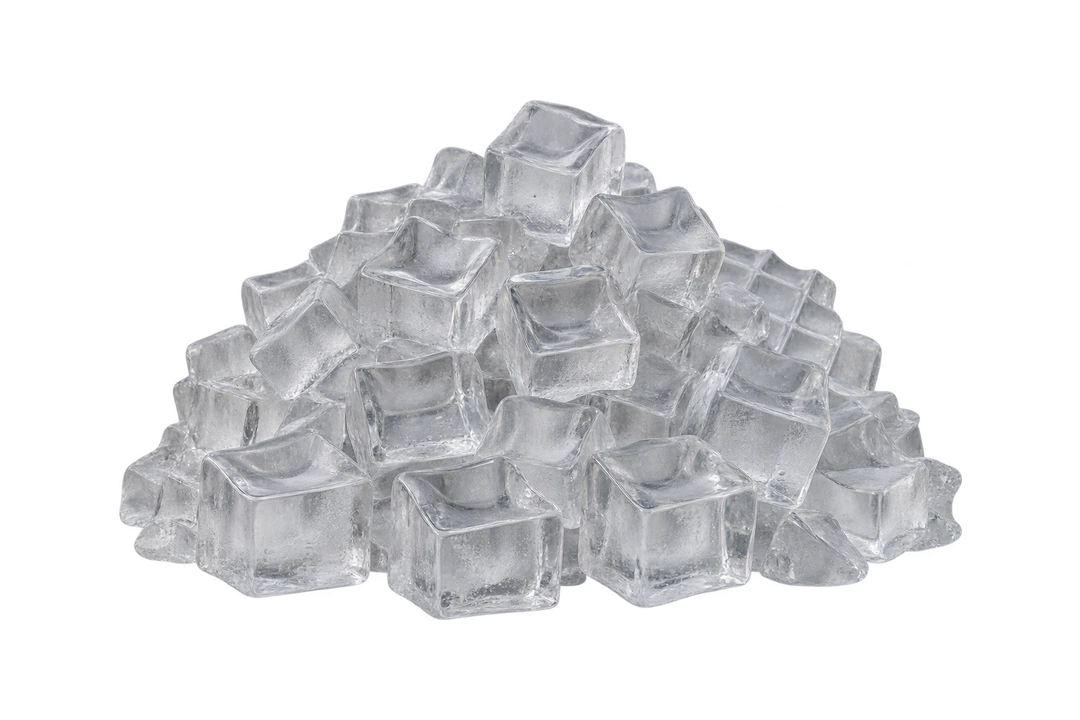
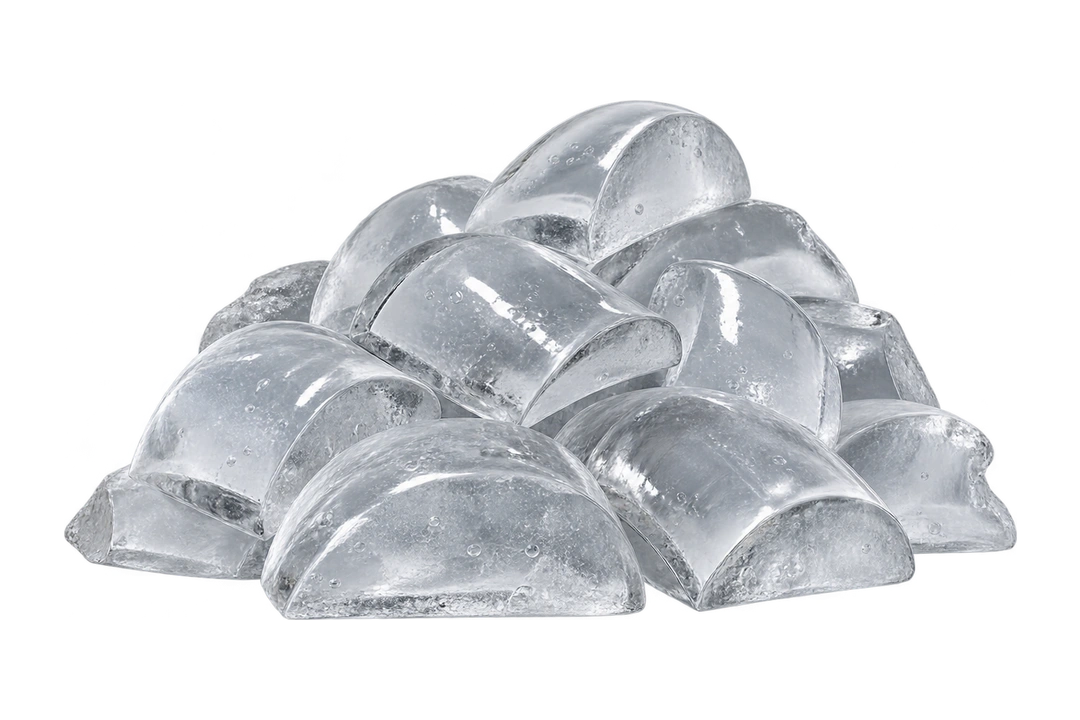
Collect representative ice using the agreed procedure and photograph it with a clear scale reference where size matters. Record when and how the observation was made.
Look at the characteristics relevant to your intended application: shape, separate or connected pieces, approximate dimensions, and the presentation the customer expects. Do not make unsupported hygiene, melting, or product-life claims from appearance alone.
Product terminology needs particular care. ICES solid cylindrical ice is individually formed, without a central hole. It should not be evaluated against a hollow tube reference. Flake, nugget, and snow are also distinct forms.
A photograph may show the shape clearly while still failing to communicate the serving quantity or handling behavior. If those matter, describe the intended task and include it in the agreed application review.
Keep ice-form approval separate from broader machine approval. An attractive sample of ice does not, by itself, verify configuration, production, storage, or service documentation.
6. Record production observations on a defined basis
A production observation needs a unit identity, conditions, method, duration, and measurement record. Without those, the result is difficult to compare or repeat.
Agree how the machine will be prepared, when collection starts and stops, how ice is handled, and what measurement equipment will be used. Where a manufacturer provides an applicable method, follow it or document the agreed alternative.
Avoid multiplying one unusually productive short interval into an unconditional daily guarantee. If an extrapolation is used for a defined review, state the method and its limits. Distinguish that result from a full-period measured value.
Also separate ice production from ice held in storage. A photograph of a full bin cannot establish how quickly the contents were made or whether the bin was empty at the start.
A factual result statement
“Sample unit [identifier] was observed using method [reference] under recorded conditions [record]. The measured result and open questions are attached.”
That is more useful than “factory testing passed” when the purchasing team cannot see what was tested.
7. Examine operation and usability without overreaching
An evaluation can include observations about access, controls, visible condition, supplied accessories, and the clarity of user instructions. Keep those observations tied to the intended customer.
For example, a distributor may ask a service partner to review whether the applicable maintenance instructions and access information are understandable. That is different from asking an unqualified user to dismantle the machine.
If noise is commercially important, agree on a suitable measurement method and conditions. A phone recording can illustrate a sound but should not be presented as a standardized acoustic result.
Similarly, visible ice clarity or a quick taste impression should not be treated as proof of water quality or food-contact compliance. Any specialist requirement needs appropriate evidence and a suitable evaluation scope.
Record both strengths and concerns in neutral language. A useful purchasing report describes what happened, not just whether the evaluator liked the product.
8. Check documents against the received version
Review the specification, installation instructions, user manual, parts information, and any other agreed documents. Confirm that their model and configuration references match the sample.
Look for contradictions across sources. If the quotation lists one power supply and the nameplate shows another, do not resolve the mismatch by guessing which document is newer. Ask for clarification and a controlled correction.
Evaluate document usability for the intended receiving team. Are the language and diagrams understandable? Can parts be identified through the provided references? Are warnings and operating conditions clear for the version being reviewed?
A translated document needs technical review as well as good grammar. A change in a unit, model identifier, or ice description can alter the meaning.
Keep document issues in the same issue log as physical observations, but identify them as document corrections. Not every problem requires a product change.
9. Use an issue log that can be closed
Give each issue a unique reference. Record the unit, observation, photograph or document, date, relevant requirement, and question for the supplier.
Classify the next action rather than assigning blame. An issue may require clarification, a revised document, a configuration correction, a repeat observation, or further technical investigation.
Agree on who reviews the response and what evidence closes the item. “Supplier replied” is not the same as “requirement confirmed.” Where a change affects the future bulk product, identify how that change will be approved and communicated.
Do not lose issues in scattered messages. A short consolidated log helps purchasing and technical teams distinguish resolved items from assumptions.
If the evaluation cannot continue safely or meaningfully because a required condition or document is missing, stop that part of the evaluation and record the reason. Continuing with an improvised setup can make the result less useful.

10. Connect sample approval to bulk-order control
When the sample review is complete, write a decision record. State the evaluated configuration, accepted items, remaining limitations, and any conditions for the next purchase stage.
Specify the reference that the bulk order will use. That might include an approved specification, configuration schedule, artwork revision, accessory list, and relevant sample record.
Agree on how proposed changes will be handled. A later part substitution or electrical version should not be treated as covered merely because a similar sample was accepted.
Sample evaluation and pre-shipment inspection also have different roles. The sample supports a product decision. Shipment inspection concerns the goods prepared for a particular order and its agreed checks. SGS describes pre-shipment inspection in terms that include quantity, quality, marking, and packing against defined requirements.
The buyer should still decide the order-specific inspection scope; neither activity establishes an unlimited guarantee.
11. A hypothetical review and follow-up
Teaching example only; not an ICES test, quotation or customer record.
Assume sample S1 is being reviewed against a buyer-approved specification. Use separate decisions for each item; the entries below illustrate record quality, not actual pass results.
| Check | Example record | Next action |
|---|---|---|
| Ice identity | Solid crescent shape matches the agreed reference photograph. | Accept the observed shape only; retain the photograph and unit identity. |
| Production measurement | No complete method or condition record was supplied. | Keep performance unverified; agree the method before measuring. |
| Electrical documents | Installation sheet and supplied nameplate identify different versions. | Resolve the mismatch with qualified review before operation. |
| Bulk-order reference | Final carton artwork remains pending. | Keep artwork approval separate from the ice-form decision. |
Keep the sample specification, installation sheet and acceptance record linked to S1. For separate certification checks, review the document identities and scopes. Use the product overview to identify the correct category.
12. Suggested sample evaluation record
Use these fields as a starting point:
- Project, buyer, evaluator, and review date.
- Unit model, ice category, identifier, and configuration.
- Quotation and specification revision.
- Evaluation objective and acceptance references.
- Receiving condition and included items.
- Installation-document reference and relevant site conditions.
- Ice-form photographs and observations.
- Production-method reference and measurement records, where agreed.
- Operation and document observations.
- Issue references, responses, and closure evidence.
- Approval status, limitations, and bulk-order reference.
Do not require every field for a simple visual review. Use the fields that make the actual decision traceable and add specialist requirements where appropriate.
The report should be readable by someone who was not present during the evaluation. That is the test of whether it can support a later purchasing decision.
Preserve the evidence after the review
Store original observation records with the final report, including genuine images, applicable document revisions, and the issue log. Keep the unit identity visible in the file structure so another team member can distinguish this sample from a later one.
FAQ
How long should an ice machine sample be tested?
There is no single duration established by this guide. Agree on the objective, applicable manufacturer method, conditions, and acceptance criteria. A short demonstration and a measured performance evaluation answer different questions.
Can I calculate daily production from a short test?
Any extrapolation needs an agreed method, documented conditions, and clear limitations. Do not present a brief observation as an unconditional full-day guarantee. Ask for the relevant manufacturer data and a suitable evaluation basis.
Does sample approval replace shipment inspection?
No. A sample evaluates a particular unit or proposed configuration. Shipment inspection checks agreed aspects of a specific order prepared for delivery. Define both activities according to the purchasing risk.
What should I do if the sample differs from the quotation?
Document the difference with the unit identity and relevant evidence. Request clarification or correction and determine whether the mismatch affects evaluation or the intended bulk product. Do not silently approve the discrepancy.
What if the ice looks right but the production record is missing?
Accept only what the review establishes. A shape photograph can support an ice-form decision, but production remains unverified until its method, conditions and measurement record are available. Keep the two decisions separate.
What does a useful final approval say?
It identifies the sample, configuration, approved requirements, unresolved limits, and reference for the next order stage. It should explain what the buyer accepted rather than offering a broad statement that everything is approved.
Conclusion
A sample evaluation is strongest when its purpose, method, conditions, and decision are visible. Establish identity, prepare the site correctly, review the actual ice and documents, and close specific issues before connecting approval to a bulk order. The result is a purchasing record your technical and commercial teams can use together.