
On this page
Introduction
An ice machine can look identical to the unit in a catalog and still have an electrical configuration that does not match the intended site. For an importer, the risk often begins before installation: the quotation names a series, the buyer assumes a familiar power supply, and nobody records the exact version being ordered.
The solution is a clear information exchange between the buyer, the manufacturer, and the qualified people responsible for the receiving site. A country name, plug photograph, or phrase such as “standard export model” is not enough.
This is a procurement checklist. It does not provide wiring instructions, conversion procedures, cable sizes, or permission to operate equipment outside its documented requirements.

1. Understand the three fields that should never be combined
Read voltage, frequency and phase as three separate requirements. Matching one field does not establish that the whole machine matches the site. The following labels explain what to collect; they do not specify an ICES model or an installation design.
| Nameplate field | Meaning for the buyer | Check |
|---|---|---|
| Voltage (V) | The rated supply voltage or voltage range | Compare with documented site supply. |
| Frequency (Hz) | The cycle rate of the AC supply | Read the exact whole-machine rating, not only a component label. |
| Phase (Ph) | The specified single-phase or three-phase supply | Have a qualified site contact verify availability. |
Power in W or kW and current in A are different quantities. They are also different from energy consumption over time. Do not use a single advertised wattage to choose protective devices or wiring; obtain the applicable installation requirements for professional review.
2. Do not infer configuration from the destination country
A country or region helps a supplier understand the buying context, but it does not identify the supply at every building or project. A distributor may also serve several markets or different types of premises.
Ask for the site information that applies to the actual installation. For stock purchases where the end site is not yet known, define which documented configurations your business intends to offer and how site compatibility will be checked before sale.
Keep destination-market evidence separate from electrical compatibility. A machine can have a proposed power supply that appears relevant while other product or installation requirements remain unresolved.
Avoid phrases such as “works everywhere” in the sales brief. They turn a configuration question into a marketing claim that may not be supported.
The buyer's task is to gather reliable information and maintain the approved record, not to make the installation decision from a generic country chart.
3. Identify the exact proposed model and version
A family name describes a product grouping. It may not distinguish every electrical version, control revision, or configuration offered within that grouping.
Request the exact model reference used in the quotation and the reference used on the equipment identification. If the buyer uses a private label name, maintain the relationship between that name and the manufacturer's technical identification.
As an example of model-specific documentation, Hoshizaki's official F-422MAK page lists electrical information for that model and provides links to relevant documents. This illustrates why a precise reference matters; its specifications should not be applied to ICES equipment.
Ask ICES which documents apply to the proposed version. Do not assume the general catalog contains every detail needed for an installation review.
If the supplier proposes an alternative model, repeat the configuration check rather than carrying forward approval from a similar-looking machine.
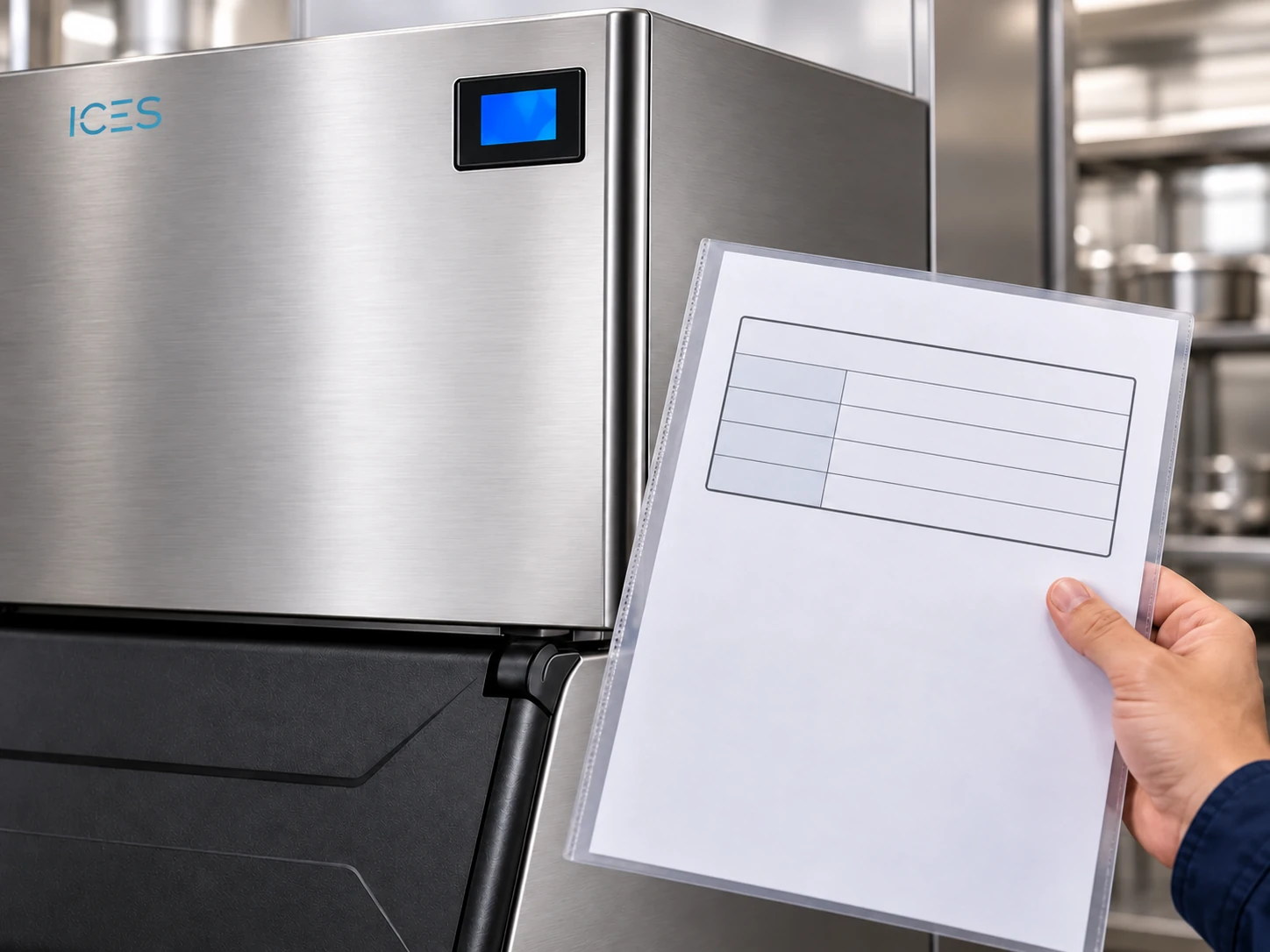
4. Treat 50 Hz and 60 Hz as a confirmation question
Frequency matters because supply frequency is part of the operating design of motors and other electrical equipment. A motor rated for one frequency cannot be treated as equivalent simply because the voltage matches. A machine contains several components, so a dual-frequency label on one component does not approve the complete machine for both supplies.
ABB explains motor nameplate frequency in relation to rated operating conditions. This is background about motors, not authorization to convert an ice machine. For procurement, request the offered whole-machine frequency rating and applicable documents. If only one frequency is documented, leave the alternative unapproved until the manufacturer resolves it.
5. Request the complete electrical document set needed for review
Ask which specification, installation instructions, nameplate information, and other relevant documents apply to the proposed machine. The qualified reviewer can then identify any additional information required for the site.
Do not confuse different electrical figures. Rated power, operating current, starting characteristics, protective-device requirements, and energy consumption are not interchangeable labels. Request the appropriate model-specific information rather than calculating one from an unrelated marketing number.
The buyer should avoid prescribing cable sizes or protective devices from a generic blog. Those decisions require applicable equipment documentation, site conditions, and local professional review.
For documentation traceability, Hoshizaki's manuals lookup illustrates the use of exact model or serial information to locate relevant documents. The broader purchasing lesson is to connect documents to equipment identity, rather than keeping one unnamed manual for an entire range.
6. Collect site information through the right people
Create a clear handoff between the commercial buyer and the installation reviewer. The buyer describes the equipment and project; the qualified local reviewer supplies or verifies relevant site information.
Include the physical location, available supply details, and the model-specific documents being reviewed. If the site has not been completed, record which information is provisional and who will confirm it later.
Do not let an installer work from a superseded quotation while purchasing approves a new version. Use one configuration record and a visible revision history.
Questions for the project team
Ask whether the actual site information is available, who has reviewed the proposed version, which documents are still missing, and whether any unresolved item prevents purchase or installation approval.
These are coordination questions, not a substitute for the review itself. The aim is to ensure that the correct people are evaluating the correct equipment.

7. Consider installation readiness beyond the power supply
Electrical configuration is one part of site readiness. The same review process should also identify questions about water supply, drainage, ventilation, positioning, access, and maintenance space.
Use the manufacturer's model-specific requirements. Do not copy dimensions or clearance values from another machine simply because it has a similar cabinet.
If accessories or separate components are needed, identify whether they are included in the quotation and who reviews their compatibility. A photograph of a complete installation does not establish the supplied scope.
For project buying, keep these items in a site-readiness register. For distribution, create a sales handoff that prevents a machine being recommended before critical site questions are answered.
The quotation comparison guide explains how installation assumptions should appear alongside the equipment and commercial scope.
8. Review samples and bulk orders as connected versions
A sample configuration should be recorded before evaluation. If the sample is intended for one destination and the bulk order for another, approval should identify the difference.
Do not assume that an accepted sample establishes compatibility for a changed voltage, frequency, or phase. Ask which further review or verification is needed for the proposed bulk version.
Keep sample records useful by identifying the unit, documents, site conditions, and questions actually evaluated. A broad statement such as “sample approved” may conceal a change that was never reviewed.
If the manufacturer proposes a substitution during production planning, return to the approved requirement. Confirm what changes, why, which documents are updated, and who approves the result.
The sample evaluation guide offers a broader framework. Configuration control is one part of that evaluation, rather than an assumption carried over from the product photograph.
9. Write the configuration into the order record
Before purchase approval, make the agreed version identifiable in the relevant commercial and technical documents. Include the model reference, configuration schedule, applicable specification revision, and supplied scope.
Where mixed configurations are being purchased, list them separately with quantities and clear receiving identification. Do not combine several versions under one ambiguous line.
Ask how the equipment and packaging will be marked so that the receiving team can connect each unit to the order. Any buyer-facing reference should still allow the technical version to be traced.
Record who may approve a change and how a revised document becomes effective. A procurement team should not discover a new configuration through a packing photograph after assuming the order was unchanged.
This record also supports later parts and service inquiries. The version purchased today becomes the information needed to understand a unit after it has entered the installed base.
10. Check consistency before shipment and on receipt
Agree on the order-specific verification scope. For configuration identity, this may involve comparing the order schedule with relevant labels, documents, and unit records.
An image should be readable and connected to the order. A distant photograph of several cabinets does not establish the electrical identity of every unit.
On receipt, compare the delivered identification and documents with the approved record. If there is a mismatch, record it and seek clarification before treating the equipment as approved for use.
Do not improvise a solution because the machine has already arrived. A changed plug, an assumption about similar components, or a successful brief demonstration does not resolve an undocumented configuration discrepancy.
Keep the issue record with the unit identity and the supplier's response. If a correction is approved, retain the relevant revised documents so the service team is not left using the earlier version.

11. A hypothetical mixed-market order
Imagine a distributor sourcing a similar ice-machine family for two separate markets. The commercial team initially requests one combined quantity because the cabinets look the same.
During review, the project team identifies different site-supply requirements. The order should now separate the proposed versions, quantities, technical references, and receiving identification.
If one sample was evaluated earlier, its approval should not silently cover both versions. The buyer should ask which documents and further checks apply to the second configuration.
This example does not establish which configurations ICES offers or imply that a specific market uses one universal supply. It illustrates why version identity should survive the move from quotation to sample, order, shipment, and service.
12. Copy-ready configuration confirmation request
“We are reviewing [model and ice type] for [destination and application]. Our current site information is voltage [verified/pending], frequency [verified/pending], and phase [verified/pending], supplied by [project source].
Please identify the proposed equipment version and provide its applicable specification and installation documents. Please also identify any remaining information required from our installation team.
If the proposed version differs from the sample or earlier quotation, please list the differences and the document revisions affected.
We will arrange the necessary local review before approving the relevant purchase and installation stage.”
This request keeps responsibility clear. It asks the supplier to identify equipment and documents while the buyer arranges site verification through the appropriate people.
13. Keep a configuration register for the installed base
After delivery, preserve the approved configuration instead of closing the record as a completed sales transaction. Link the unit identity to the destination, customer reference, applicable manuals, and service contact.
When a parts question arises, provide the exact model and identifier rather than only the public product name. If the machine has been modified, disclose the approved changes and retain the related records.
For repeat orders, compare the new proposal with the existing register. A familiar cabinet or model family should prompt a version check, not an automatic assumption of equivalence.
This record can also reveal recurring information gaps. If site-supply details are repeatedly missing from inquiries, improve the sales qualification form. That is a more useful response than relying on staff to remember which questions were missed last time.
Check the final approval handoff
Before releasing the order, ask the purchasing and project contacts to confirm that they are reviewing the same proposed version. Identify any provisional field and the person responsible for closing it.
FAQ
Can a 50 Hz ice machine be used on a 60 Hz supply?
Not on that information alone. Frequency is part of the electrical operating specification. Check the rating and applicable documents for the complete supplied version; matching voltage or a dual-rated component is insufficient. Obtain manufacturer confirmation and qualified installation review rather than attempting a conversion.
Is voltage information alone sufficient for a quotation?
It is incomplete for a configuration review. Provide frequency and phase information as well, identify the destination and application, and ask the supplier which additional site details are required.
Can I identify compatibility from the plug?
A plug photograph does not establish the complete equipment configuration or site suitability. Use the machine identification, applicable documents, and qualified local review.
Are machines in the same product family electrically identical?
Do not assume they are. Request the exact proposed version and its documents. If alternatives are offered, record which version is approved for each quantity and destination.
Who should decide cable and protective-device requirements?
Suitably qualified local professionals should review the actual site and applicable equipment documentation. A general procurement article should not prescribe universal values.
What if the delivered nameplate differs from the order?
Record the unit identity, the mismatch, and the relevant documents. Seek clarification before treating it as approved for use. Do not resolve the discrepancy through an undocumented field modification.
What should a distributor retain for future service?
Keep the exact model, unit identifier, approved configuration, applicable documents, and any authorized change records. These references help distinguish equipment that may share a commercial family name.
Conclusion
Electrical compatibility begins with accurate purchasing information. Confirm the site's supply, identify the proposed machine version, connect it to applicable documents, and maintain that record through approval, shipment, and service. Clear coordination reduces the chance that an assumption becomes an equipment mismatch.
Use the ICES product range to identify the series, then bring the electrical brief to a distributor or OEM project discussion. Keep the site requirement and the offered version in the same record.