On this page
Introduction
A useful quotation starts before the price request. The supplier needs to understand what you intend to buy, where the machines will be sold or installed, and which questions still require advice. Without that context, the first response may be a broad catalog or an offer based on assumptions.
For importers and distributors, the aim is not to send an unnecessarily long form. It is to provide enough information for a relevant proposal and to make unknowns visible.
This guide includes a copy-ready request-for-quotation template. It is public so your team can use it before contacting ICES or another supplier.

1. Explain who you are buying for
Start with your business role. An equipment distributor building a stock range has different needs from a contractor buying for one restaurant project or a brand team developing a private label line.
Describe your primary customer segments and sales channel. Useful examples include beverage-service equipment dealers, hospitality project suppliers, commercial refrigeration distributors, and brand owners serving foodservice businesses.
You do not need to disclose confidential customer names during an initial discussion. A short description of the intended operation can give the supplier enough context to ask better questions.
Also explain the purchasing stage. Are you exploring a category, evaluating a sample, comparing quotations, or preparing a defined order? An indicative inquiry should not be presented as a firm purchase commitment.
A concise company introduction
“We distribute commercial foodservice equipment in our market. We are reviewing ice machines for café and restaurant customers and would like to compare suitable models before planning a sample evaluation.”
This explains the commercial purpose without inventing order volume or urgency.
2. State the destination and separate it from the delivery point
Identify the destination country or region and, when known, the intended installation location. For a distributor, explain whether the machines will be held in stock or supplied to a defined project.
The sales market and the first delivery point may be different. A buyer might receive goods through a logistics hub before distributing them elsewhere. Make that distinction visible so that configuration and document discussions are not based only on the shipping address.
If you want a delivery quotation, provide the named destination information appropriate to the requested scope and ask the supplier to state what is included. Keep preliminary logistics estimates separate from agreed commercial terms.
Avoid asking a supplier to confirm universal “global compliance.” Instead, identify the destination and the exact evidence your buying process requires. Unknown destination requirements should be investigated with suitable local support rather than guessed.
3. Describe the required ice before choosing a model
Tell the supplier which ice form your customers expect. If terminology is uncertain, attach a reference photograph and describe the application.
The current ICES range includes cube, crescent, flake, solid cylindrical, nugget, and snow ice machines. These categories should not be merged because two product names sound similar. ICES cylindrical ice is individually formed and solid, with no central hole. Snow refers to the specified fine ice texture, not a flavored dessert machine.
If you are unsure, explain the serving or handling task. For example, “We need to compare ice forms for cold beverage service” is a useful starting point. It is better than choosing a category solely because a competitor uses that word.
Review the six ice types before sending the inquiry. Ask for representative ice images or sample information where the distinction affects the purchase.

4. Provide demand information without inventing a sizing answer
If you already have an output requirement, state it and explain its basis. If you do not, describe normal usage, the busiest service window, operating hours, and how the customer currently obtains ice.
Keep daily usage separate from peak demand and storage. “We need ice for a busy evening service” does not tell the supplier how much is used or how much can be accumulated beforehand.
For a distributor developing a range, describe the customer sizes or applications you intend to serve rather than applying one production figure to every account. You can ask the supplier to identify catalog options for further review.
Nominal kg/24h figures should be checked against the conditions and documentation for the proposed version. Do not demand a site-performance guarantee based only on a general catalog value.
The inquiry should create a selection conversation, not disguise incomplete information as a finished engineering specification.
5. List model interests and quantities separately
If you know the model references, list them exactly. Include the relevant ice type because similar identifiers may appear across different categories.
Provide an indicative quantity for each item and explain the purchase stage: sample, trial batch, stock order, or project requirement. If the quantity is undecided, say so.
Avoid combining several models into one total without a mix. Different equipment combinations can affect packing, documentation, configuration review, and the commercial proposal.
Do not assume a sample price or a bulk price will remain valid for a different quantity. Ask the supplier to state the quotation basis and any conditions attached to it.
For ICES, model references should be checked against the catalog. A model name is not a substitute for its stated nominal output. The crescent range, for example, extends to 450 kg/24h, rather than an output inferred from a model number.
6. Collect electrical and installation information
Prepare the known voltage, frequency, and phase information for the intended site. For a distributor serving multiple site types, explain which configurations need to be considered.
If those details have not been verified, mark them as pending. Ask a qualified local installation professional to provide the site information rather than guessing from a country name or plug shape.
Also provide known physical constraints: available footprint, height, access route, ventilation context, water connection location, and drainage arrangements. You do not need to design the installation in the inquiry. You need to identify the conditions that could affect selection.
Ask for the proposed model's applicable installation documents so that your team can review them. The electrical configuration checklist explains which records should be connected.
7. Describe branding and packaging requests by item
A request for “OEM service” can mean anything from a logo to a changed product design. List the actual work you want considered.
Possible discussion items include logo placement, carton artwork, buyer-facing model references, document language, photography needs, and product changes. Separate presentation requests from engineering requirements.
Provide reference files where available, but do not assume feasibility or price before review. A desired cabinet dimension or control change may need a different process from a label layout.
For packing, explain any known receiving or handling requirement. Ask the supplier to identify the proposed packing method, dimensions, gross weight, and information still subject to final confirmation.
Use the OEM and ODM guide for a fuller scope discussion. There is no universal minimum order or development schedule implied by a request to use your brand.
8. Specify documents and sample questions
Prepare a short list of documents needed for the next decision. At the inquiry stage, the priorities may be the current catalog, a proposed-model specification, installation information, and a clear quotation scope.
For later stages, you may need manuals, parts references, packing information, or applicable product evidence for the destination. Ask which documents can be provided and identify any required language or review format.
If a sample is under consideration, describe what you want to evaluate. Appearance, ice form, configuration, operation, and packaging are different objectives. A sample discussion should lead to an agreed scope rather than a vague request for “one unit to test.”
Ask about the relationship between the sample and the intended bulk version. If there will be differences, they should be documented before approval.
Do not request fabricated certificates or accept unrelated reports merely to complete a checklist. Evidence needs to match the proposed equipment and its intended use.
9. Explain your local support arrangements
A distributor's service plan affects the information needed from a supplier. Tell the manufacturer whether you have an internal technical team, use independent service partners, or are still developing local support.
Ask which model-specific parts references and service documents can be discussed for the proposed range. Explain any training or technical communication requirements without assuming the supplier already offers them.
If you expect an initial spare-parts package, ask how it should be selected. An arbitrary percentage of the order value is not a substitute for considering the installed base, component compatibility, and actual support plan.
Keep warranty questions concrete. Request the applicable written terms and ask which activities, costs, and evidence they cover. “Full support” is too broad to use as the basis for a distributor commitment to its customers.
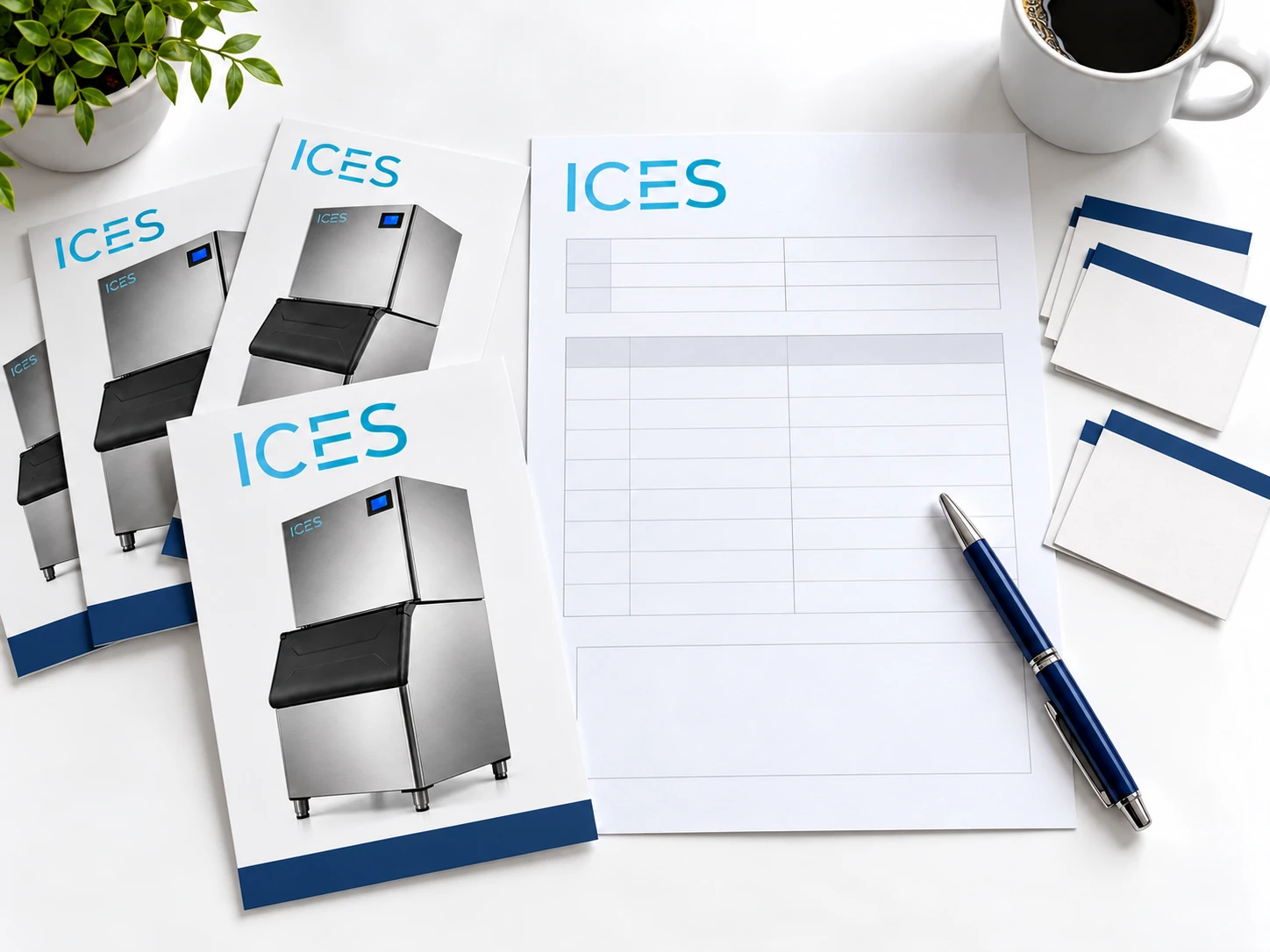
10. Copy-ready wholesale inquiry template
Subject
Wholesale Ice Machine Inquiry — [Market] — [Ice Type or Application]
Message
Hello,
We are [company name], a [distributor/importer/wholesaler/brand/project buyer] serving [customer segment] in [market].
We are reviewing ice machines for the following requirement:
- Destination market: [country/region].
- Intended application: [customer use or project description].
- Required ice form: [type or attached reference; pending if uncertain].
- Model interests: [exact references and category, if known].
- Demand information: [daily use, peak period, operating hours, or selection question].
- Quantity by model: [sample/indicative trial/bulk/project quantity].
- Known supply: [voltage, frequency, phase; pending fields identified].
- Site constraints: [space, access, water, drainage, ventilation information].
- Branding requirements: [none, logo, packaging, documents, or changes to review].
- Required documents: [specification, installation information, other applicable evidence].
- Sample objectives: [what we need to verify, if relevant].
- Support requirements: [parts information, manuals, service communication questions].
- Requested quotation scope: [equipment, accessories, packing, proposed delivery basis].
- Target purchasing stage and timing: [current decision and desired schedule].
Please identify the proposed model and configuration, included items, outstanding questions, quotation basis, and documents available for review.
Our contact details are [name, business email, telephone, company, country].
Thank you.
How to use the template
Delete items that are irrelevant, but leave important unknowns visible. If you attach a reference image, explain whether it shows the required ice, an installation constraint, or a machine you currently use. A photograph without that explanation can be interpreted in several ways.
11. Keep the first exchange focused
Do not wait for every field to be perfect before starting a discussion. Send a coherent brief and identify the decisions where you need help.
Assign one person to consolidate technical and commercial answers. If different team members send different quantities or electrical assumptions, the resulting quotations may not be comparable.
Save the brief revision with the supplier's response. When the requirement changes, issue a clear update rather than relying on a long chain of informal messages.
After receiving proposals, move to the quotation comparison guide. Its role is to align actual offers. This article's role is to help those offers begin from useful information.
A focused inquiry does not guarantee a particular price or response time. It gives both sides a clearer basis for deciding what to discuss next.
A short first-contact message
Use the detailed template above when your purchasing scope is established. If you are still exploring, this shorter message is enough to start; unknown technical fields can stay open.
Hello ICES, we supply [customer sector] in [market] and are exploring [ice type or application]. We would like help comparing suitable series and understanding sample options. Our initial quantity is [estimate or undecided]. Please tell us what information would help you prepare a relevant proposal.
You can start a conversation before every specification is settled. Share what you know through Contact, or review distributor cooperation and brand projects for the next steps relevant to your business.
FAQ
Can I request a quotation without knowing the model?
Yes. Describe your market, customer application, required ice form, known demand, and installation information. Ask for a shortlist and identify the questions that still need review rather than choosing a model arbitrarily.
What should I do if I do not know the required capacity?
Provide the information behind the demand: normal usage, busiest period, operating hours, and storage expectations. Ask for selection guidance and request the production conditions for any proposed model.
Should I send my entire business plan?
No. Provide information relevant to product selection and the commercial discussion. You can describe customer segments and indicative requirements without disclosing confidential accounts or an unsupported sales forecast.
Must the destination power supply be known before the first contact?
You can begin a discussion with that field pending. It should be verified and connected to the proposed configuration before the relevant purchase approval. Do not substitute an assumption based only on the destination country.
How should mixed-model orders be described?
List each model or ice category, its indicative quantity, configuration needs, and purchase stage. Ask the supplier to explain any limitations or questions affecting the proposed mix and packing.
Should I request the full catalog or a detailed quotation first?
If your range is undecided, ask for the catalog and explain your application. If you have a defined shortlist, request model-specific specifications and an itemized quotation. The two requests support different stages.
Conclusion
A wholesale inquiry is most useful when it explains the buying context and separates confirmed requirements from open questions. Provide the market, application, ice type, quantity basis, configuration information, and next decision. That creates a stronger starting point for selection, quotation comparison, and sample planning.