
On this page
Introduction
A distributor's relationship with an ice machine does not end when the equipment is delivered. Customers will need operating information, maintenance guidance, parts identification, and a clear route for reporting problems. Those needs become harder to manage when the distributor has no record of the exact supplied version.
After-sales planning should therefore begin during supplier evaluation and range development. It should establish what the distributor will handle locally, what information the manufacturer needs, and which arrangements must be confirmed in writing.
This guide is for importers, distributors, and private label teams. It does not claim that ICES has overseas parts warehouses, a global repair network, or a particular service response commitment.

1. Define the support model before expanding sales
Decide how your business intends to support customers. You may have qualified internal technicians, work with local service partners, or be building that capability.
Identify which tasks your team can perform and which require further resources. Commercial customer communication, technical diagnosis, parts approval, and repair work are distinct activities. Assign ownership rather than assuming one contact will manage everything.
Ask the supplier which documents and communication arrangements can be discussed for the proposed equipment. Explain your intended market and installed-base plan so the conversation relates to an actual business requirement.
Start with a responsibility map
List who receives a customer report, who gathers information, who performs the relevant technical review, who contacts the manufacturer, and who authorizes the commercial next step.
The map is a proposed operating method. It does not create a warranty entitlement or authorize unqualified technical work. Those matters depend on the actual equipment, people, and agreements.
2. Build the installed-base register around unit identity
Record the exact model, serial or other supplied unit identifier, electrical configuration, relevant revision, customer location, delivery date, and applicable documents.
Link the buyer-facing model name to the manufacturer's technical reference. This is especially important for private label equipment or repeat orders that may contain different versions.
A public example shows why identification matters: ZIEGRA's service page asks customers for machine type and serial information when requesting parts. The particular identification format belongs to that manufacturer; it should not be transferred to ICES.
The practical lesson is to preserve the identifiers supplied for your actual equipment. A photograph of an unmarked cabinet or a general sales name may not give the supplier enough information to identify a compatible part.
Do not wait for the first service case to discover that receiving records contain only a shipment total.
3. Request parts information for the proposed versions
Ask which parts references are available for the models under discussion. Useful information may include part numbers, descriptions, diagrams, applicable versions, and any conditions affecting compatibility.
Keep the request specific. “Please send all spare parts” may produce a broad list that does not identify what fits the equipment you intend to import.
Clarify how updated references will be communicated. If a component changes between orders, the distributor needs a method for distinguishing the relevant units and avoiding an unsupported substitution.
Also ask which parts should only be selected or fitted through an appropriate technical process. A parts list does not, by itself, establish that every component is suitable for untrained replacement.
For another documentation example, Hoshizaki's manuals system uses model or serial references to locate relevant material. The distributor's goal is the same kind of traceability for its own supplied equipment, not the adoption of another manufacturer's documents.
4. Separate maintenance items, diagnostic needs, and repair parts
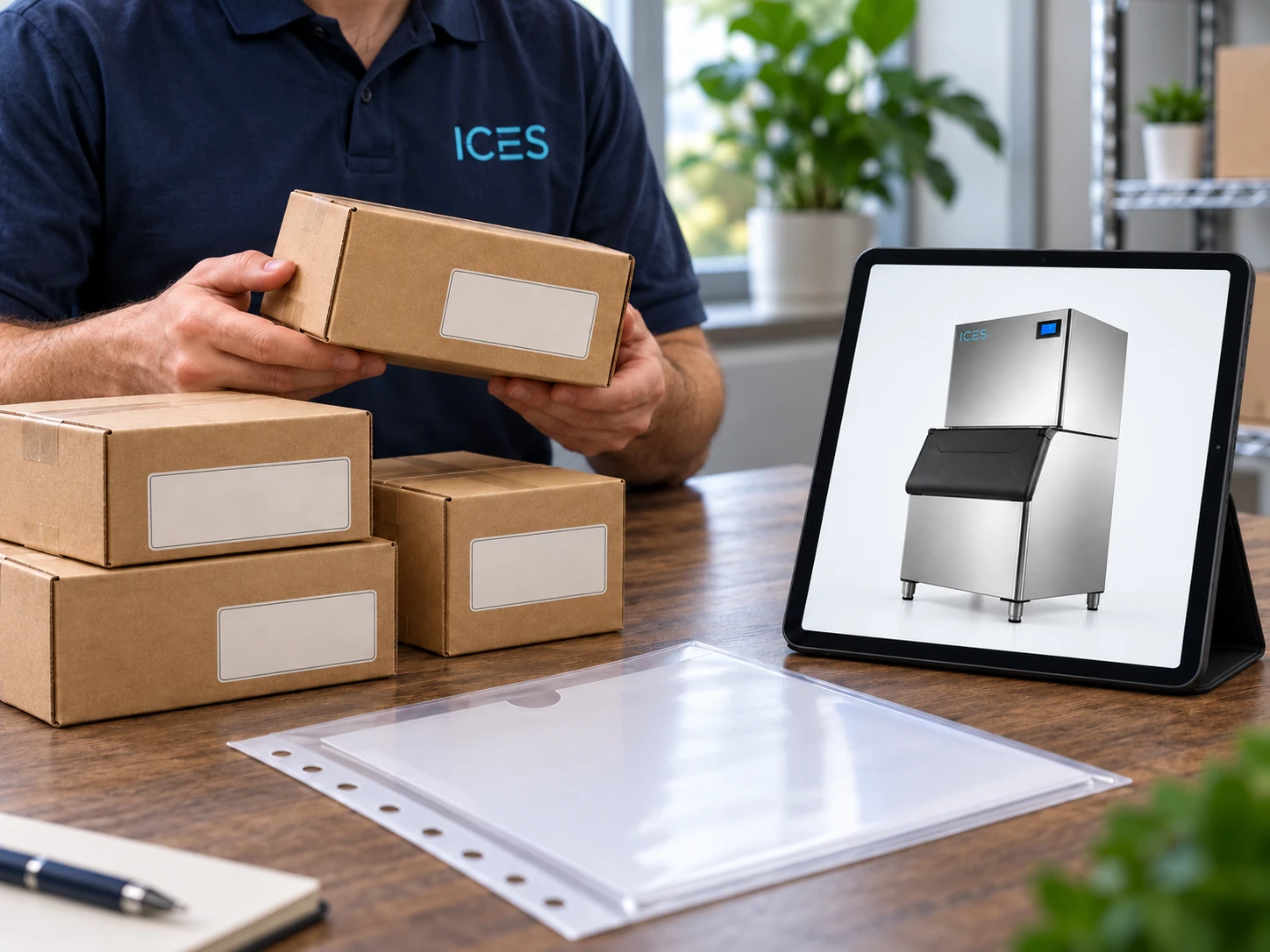
Classify each proposed item before ordering an initial package. The examples describe planning categories, not a universal ICES spare-parts list. Compatibility, maintenance requirements and replacement work still depend on the exact equipment and applicable instructions.
| Planning category | Information needed | Purchasing decision |
|---|---|---|
| Scheduled maintenance materials | Applicable manual, approved item, service schedule and storage limits | Plan from the documented maintenance need, not a generic interval. |
| Parts selected after diagnosis | Unit identity, symptom record and confirmed part applicability | Confirm the reference before stock or dispatch. |
| Higher-value assemblies | Installed population, compatibility, supply time and local support capability | Weigh replenishment delay against stock cost; use recorded service history when available. |
5. Plan inventory from exposure rather than invented failure rates
Start with the actual or planned installed base by model and version. Add relevant supplier information about part availability, ordering arrangements, lead-time estimates, and packaging quantities.
Then consider your support model: geographic coverage, customer expectations, local service access, and the time needed to obtain parts. A remote project and a concentrated city-based installed base may create different logistics questions.
Do not apply a fixed percentage of machine value and call it a technical stocking plan. Nor should you invent a failure rate to justify a bundle.
Where historical service records exist, use them carefully. Record the installed population and observation period alongside case counts. A few early reports from a small population do not establish a reliable long-term rate.
Where records do not exist, mark the initial plan as provisional. Agree on a review point after real installation and service information becomes available.
6. Create a useful technical-case intake
A service conversation is easier to investigate when the first report identifies the equipment and describes the symptom clearly.
Useful intake fields include the model, unit identifier, configuration, installation location, date first observed, symptom, relevant operating conditions, and any displayed message. Add genuine photographs or video where appropriate.
Ask what changed before the problem appeared. A recent relocation, supply interruption, maintenance activity, or operating change may be relevant context, but should not be treated as proof of the cause.
Distinguish observations from conclusions. “Ice was not observed during this period” is an observation. “The compressor is defective” is a diagnosis that requires suitable evidence.
Do not request unsafe demonstrations. The customer should not remove protective parts, bypass controls, or perform electrical work merely to provide a better video.

7. Use a case record instead of scattered messages
Assign a reference to each case and keep the supporting material together. Record the report, supplier questions, technical review, proposed action, and outcome.
Separate the technical question from the commercial decision. Determining which part may be needed is not the same as deciding whether its supply is covered by a particular agreement.
Keep communication factual. A concise timeline is more useful than several conflicting accounts. Identify who observed the issue and which documents or images support the record.
Where the case remains unresolved, state the next action and responsible person. “Waiting for support” is less useful than “awaiting readable nameplate photograph from the site contact” or “awaiting applicable parts reference confirmation.”
The aim is an understandable handoff between customer-facing staff, qualified service personnel, purchasing, and the manufacturer.
8. Confirm compatibility before ordering replacement parts
Match the proposed part to the exact equipment identity and relevant manufacturer reference. Do not order solely because a part looks similar in a photograph.
If the proposed part reference differs from an earlier record, ask whether it is a documented replacement and what conditions apply. Keep the confirmation with the case.
For electrical or control-related components, the equipment configuration and revision may be important. The distributor should provide complete identity information and let qualified reviewers determine the applicable selection.
After receiving parts, compare the supplied reference and quantity with the approved request. Keep items identifiable during storage and delivery so that a correct order does not become an incorrect field issue.
Where the application is uncertain, resolve the question before dispatch or installation. Fast movement of an unidentified part does not create a reliable service outcome.
9. Write warranty and commercial responsibilities clearly
Request the applicable written terms for the proposed supply arrangement. Identify the responsible entities, coverage basis, claim process, and evidence requirements.
Ask how approved parts are supplied and which activities or costs are included or excluded. Local labor, transport, customs handling, installation, and other expenses should not be inferred from a general warranty statement.
If your brand makes a customer-facing commitment, check how it relates to the supplier arrangement and your local obligations through appropriate review. Do not copy a competitor's terms or assume one global policy applies.
Record any support commitments separately where necessary. A technical communication channel, a parts quotation process, and a warranty remedy are different subjects.
This article does not interpret a specific warranty or promise a result. Its purpose is to ensure that procurement asks the questions before the distributor makes unsupported commitments to customers.
10. Prepare parts logistics as a controlled process
Discuss how parts orders are identified, quoted, packed, and shipped. Record the destination contact, part references, quantities, and relevant case identifiers.
Ask which availability and lead-time information is current and which is only an estimate. Do not convert a preliminary answer into a fixed promise to the customer without confirmation.
Keep shipment records linked to the case and inventory register. On receipt, check labels and condition, then record where each item is stored or allocated.
For returned items, clarify whether return is required, how it is authorized, and which instructions apply. Do not ship a component back merely because an old message suggested that returns are sometimes needed.
The logistics plan should support technical traceability. A carton arriving quickly is not useful if the receiving team cannot tell which equipment or case it belongs to.

11. Maintain documents through product changes
A distributor's service library should evolve with the supplied equipment. Keep applicable manuals, parts references, configuration records, and approved changes connected to the installed base.
Mark superseded files so staff do not unknowingly use them for new equipment. Retain historical references where they still apply to older units.
For private label products, keep the public model name and technical identity linked. A rebranded manual should not remove the information needed to identify the correct version.
Ask how the manufacturer communicates changes and which buyer approvals are needed for repeat orders. A product-range review should include service implications, not only the sales appearance.
The OEM and ODM guide discusses change scope and approvals. The same discipline helps after-sales teams understand which equipment they are supporting.
12. A hypothetical parts case
Teaching example only; not an ICES test, quotation or customer record.
A useful first message says: “Unit [model/serial/version] at [site] shows [observed symptom] since [time]. The attached nameplate and safe external photographs identify the unit. Relevant operating conditions and recent changes are [record]. Please advise which additional information is needed before selecting parts.” This reports observations without diagnosing a failed component from a cabinet photo.
Connect the case to the distributor support discussion and the correct product category. Keep warranty coverage, technical diagnosis and parts ordering as separate decisions; the intake example does not promise a particular response time or remedy.
13. Measure support quality with useful definitions
Track the information that helps improve the process. Examples include cases missing unit identity, requests awaiting customer information, parts supplied against confirmed references, repeat questions about documents, and cases reopened after an incomplete handoff.
If you measure response or resolution time, define the starting and ending points. A case waiting for site access is different from one waiting for a supplier document.
Do not publish flattering averages without explaining their basis. Internally, use the records to identify what can be improved: intake, document quality, parts identification, logistics, or local technical resources.
Review findings with purchasing before repeat orders. After-sales feedback can reveal a need for clearer configuration labels or better sales qualification even when no product change is required.
A useful service plan creates learning as well as case closure.
14. Pre-order distributor support checklist
Before approving a wider range, review the following questions:
- Can every supplied version be identified after delivery?
- Which manuals and parts references apply?
- Who gathers the customer's initial report?
- Which qualified people perform technical work locally?
- What information does the manufacturer need for a case?
- How are compatible parts confirmed and ordered?
- Which initial stock decisions are supported by evidence?
- What written warranty and commercial terms apply?
- How are product and document changes communicated?
- When will the support plan be reviewed using real records?
The checklist can be used during a wholesale inquiry or supplier discussion. It should lead to specific answers, not a generic assurance that everything is supported.
FAQ
Which spare parts should a new distributor stock?
Begin with the proposed models, versions, installed-base plan, available manufacturer references, and local support needs. Request a justified list for review rather than applying a universal package or invented failure rate.
Are parts interchangeable within one model family?
Do not assume so. Confirm applicability using the exact equipment identity and relevant manufacturer information. Similar appearance or a shared public name is not enough.
What should accompany a service request?
Provide the model, unit identifier, configuration, clear symptom, relevant conditions, and genuine supporting images or records. Separate observed facts from unverified diagnosis.
Does warranty automatically include local repair labor?
Do not infer coverage. Review the applicable written terms and clarify activities, costs, responsibilities, and the claim process for the actual supply arrangement.
Does an initial spare-parts package replace local service capability?
No. Stock does not establish diagnosis, compatibility or safe installation. The distributor still needs an intake process, applicable documents and qualified local service arrangements. Select parts around that support plan rather than treating a box of components as a complete service system.
How often should parts stock be reviewed?
Choose a review interval appropriate to your installed base and logistics, then update the plan using actual cases, current availability, and product changes. This guide does not establish one universal interval.
Conclusion
After-sales readiness depends on identity, documentation, qualified people, and clear responsibilities. Build those foundations before the installed base grows. A distributor that can connect a customer report to the correct equipment and parts reference has a more useful process than one relying on broad promises.